Top 5 Web3 Security Tools in 2026
Protect your crypto with the best Web3 security tools in 2026. Compare Kerberus Sentinel3, MetaMask, hardware wallets, and contract scanners. Learn how to prevent phishing, wallet drainers, and smart contract exploits.
Web3 adoption continues to grow, but so do security threats. In the first half of 2026, over $3.1 billion was stolen from Web3 users and platforms through phishing attacks, wallet drainers, and smart contract exploits.
This guide covers five essential Web3 security tools for 2026, from browser extensions that detect threats in real-time to hardware wallets for cold storage. We'll also cover common scam types and practical security practices.
What Are the Most Common Web3 Scams?
Understanding the threat landscape is the first step to protecting yourself. Web3 scammers deploy increasingly creative fraud schemes designed to catch you off guard. Here are the most common threats:
- Phishing websites - Fake sites mimicking legitimate platforms (like "opensun.io" instead of "opensea.io") that steal your wallet credentials. Phishing is now the #1 attack vector, responsible for over $600 million in losses in 2024.
- Malicious smart contracts - Contracts with hidden dangerous logic like the ability to drain your entire wallet, pause transactions, or burn tokens without permission.
- Wallet drainers - Malicious signing requests disguised as authentication that empty your wallet the moment you approve them.
- Rug pulls - Projects that build hype, collect investor money, then vanish without a trace.
- Poisoning attacks - Scammers create fake addresses similar to ones you've used before, hoping you'll accidentally send funds to them.
- Copymints & fake NFTs - Plagiarized collections with zero value that can't be resold on legitimate marketplaces.
- Fake airdrops - Phishing emails claiming you've won free tokens, linking to sites that drain your wallet when you connect.
- Impersonation - Fraudsters pretending to be crypto celebrities or project team members to trick you into revealing credentials.
Top 5 Web3 Security Tools in 2026
After analyzing dozens of Web3 security solutions, these five tools stand out for their effectiveness, user base, and track record.
Each serves a different purpose in your security stack.
1. Kerberus Sentinel3 — Best Overall Web3 Protection

Web3 security tool with a $30k safety net. Zero losses.

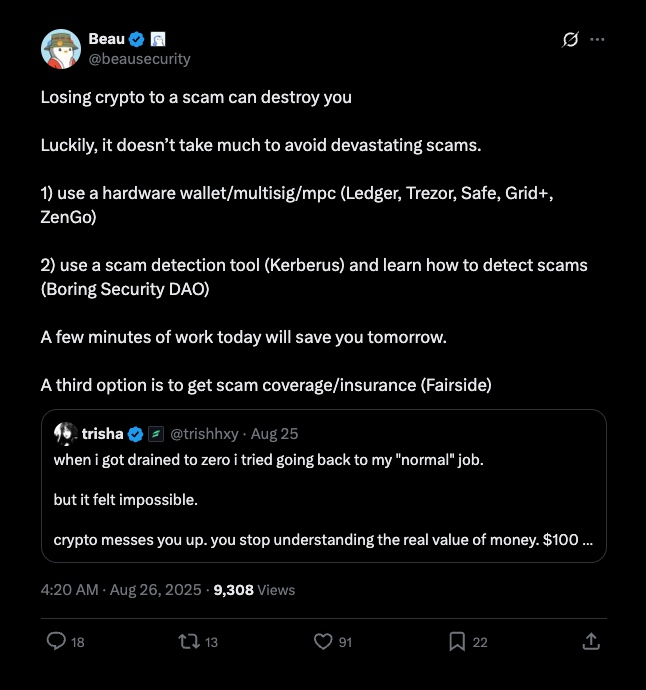
Kerberus Sentinel3 is a browser extension for Web3 security. It gives you real-time scam detection and up to $30,000 in transaction coverage.
Kerberus Sentinel3 is a browser extension for Web3 security that gives you real-time scam detection and up to $30,000 in transaction coverage. Created by a cybersecurity expert with 15+ years of white-hat hacking experience (including top-10 recognition at PayPal and hall of fame at Dropbox), Kerberus has achieved what no other tool can claim: zero user losses in over two years.
Why Kerberus is #1
Kerberus Sentinel3 offers the most comprehensive Web3 security protection available. It works silently in the background—like banking fraud prevention, but for Web3. It's not just another blocklist. This is real-time detection for new scam sites that launches the moment they appear.
Key Features:
- 99.9% scam detection rate with automatic, real-time blocking before threats reach you
- Zero user losses in over two years of operation—an unmatched track record
- All EVM chains and Solana supported—comprehensive multi-chain protection
- AI-powered detection that identifies malicious sites the moment they launch, not relying on outdated blocklists
- Transaction simulation shows exactly how your assets will change before every signature
- Up to $30,000 coverage backed by Fairside—if their system misses a threat, you're covered with reimbursement up to $30,000 in USDC
Game-Changing Acquisition: In August 2026, Kerberus acquired Pocket Universe (formerly the #2 independent security tool) in one of the largest B2C Web3 security deals ever, bringing Pocket Universe's 200,000+ users under Kerberus protection. This consolidation creates an even more powerful security ecosystem.
Enterprise-Grade, Consumer-Simple: Unlike other tools that bombard you with confusing warnings, Kerberus works automatically in the background. Most Web3 security tools expect you to catch scams by interpreting alerts and making split-second decisions. Kerberus protects you in the moments you can't protect yourself—no decisions needed, no warnings to interpret, just real-time protection that stops threats instantly.
Pricing: Kerberus offers a Free tier with transaction simulations so you can see exactly what a contract will do. The Pro plan includes automated scam detection and the $30,000 coverage—making it less than a few coffees a month for peace of mind that could save you thousands.
Developer API: For founders and developers, Kerberus offers an API that can be integrated directly into wallets or dApps. It's a revenue-generating API with no upfront costs or ongoing fees—you can earn from DEX trades made through your app while providing enterprise-grade protection to your users.
Available on: Chrome, Brave, and other Chromium browsers
2. Pocket Universe (Now Part of Kerberus) — Transaction Simulation Excellence
Note: As of August 2026, Pocket Universe was acquired by Kerberus. Existing users benefit from enhanced Solana protection and AI-driven capabilities while maintaining Pocket Universe's trusted transaction simulation features.
Pocket Universe remains one of the most trusted names in Web3 security, known for its precise transaction simulation and clear warnings. With over 200,000 users before the acquisition, it's proven its value by detecting scams that other tools miss.
Key Features
Pocket Universe's transaction simulation technology helps you understand exactly what will happen before you sign:
- Transaction simulation on forked blockchain copy to predict outcomes before you sign
- Detailed signing request breakdowns showing exactly what assets move
- Detection of wallet drainers, fake collections, and phishing pages
- Visual previews of asset movements
- Rug detection that warns if tokens were launched by serial rugpullers
- Up to $20,000 transaction coverage
- Integration with trading platforms like Dexscreener, Photon, Pump.fun, and BullX
Pocket Universe excels at showing you the "what if" scenario before you make a costly mistake. Its strength lies in making complex blockchain transactions human-readable and understandable.
Supported chains: Ethereum, Polygon, Arbitrum, BSC, Optimism, Base, Blast, Linea, Scroll, Taiko, and Zora
Available on: Chrome, Brave, Edge, Firefox
3. MetaMask — Most Popular Wallet with Built-In Security
MetaMask isn't just the most popular Web3 wallet—it's now one of the most secure, thanks to the integration of Wallet Guard's security engine following Consensys' acquisition in 2024.
Key Security Features
MetaMask's integrated security features protect you without needing additional extensions:
- Built-in phishing detection using Wallet Guard's Stormwatcher ML algorithms
- Transaction simulation showing what contracts and assets are involved before signing
- Human-readable transaction insights that translate complex blockchain operations
- Warnings on malicious transactions before they execute
- Hardware wallet support for Ledger and Trezor devices
- Portfolio tracking across multiple chains
- Snap ecosystem allowing third-party security extensions
What Makes MetaMask Unique: With over 30 million monthly active users, MetaMask has the resources to integrate best-in-class security directly into the wallet. The Wallet Guard acquisition brought enterprise-grade threat detection that now protects all MetaMask users by default—no separate extension needed.
Critical Note: Always keep MetaMask fully updated to benefit from the latest security features. Enable transaction insights and pay attention to warnings.
Available on: Chrome, Firefox, Brave, Edge, iOS, Android
4. Hardware Wallets: Ledger & Trezor — Your Offline Fortress
Hardware wallets are non-negotiable for serious crypto holders. These physical devices keep your private keys completely offline, immune to remote hacking attempts. Both Ledger and Trezor released new 2026 models with major security upgrades.
Ledger Nano Gen5 ($179)
Ledger's latest "signer" (they've moved away from calling them wallets) features:
- Larger touchscreen with improved user interface
- Bluetooth connectivity for mobile use
- Ledger Recovery Key for optional seed phrase backup (controversial but optional)
- 5,500+ supported cryptocurrencies
- Secure Element chip (EAL6+ certification, same as passports)
- Staking support for major coins (ETH, SOL, ADA, COSMOS, etc.)
- NFT management integrated into Ledger Wallet app (formerly Ledger Live)
- Zero successful remote hacks in the Ledger Nano series history
Design Note: Developed with iPod creator Tony Fadell and Apple icon designer Susan Kare
Trezor Safe 7 (€249)
Trezor's next-generation wallet introduces:
- Dual secure element architecture combining TROPIC01 chip with EAL6+ element
- Quantum-ready design capable of receiving post-quantum cryptographic updates
- Bluetooth & wireless charging (first Trezor with iPhone connectivity)
- Touchscreen with Gorilla Glass 3 and aluminum casing
- 100% open-source software (though the Safe models now use a secure element)
- Shamir Backup splits recovery phrase into multiple shares for enhanced security
- 9,000+ supported tokens via third-party integrations
- Passphrase protection creates hidden wallets invisible even with seed phrase
Which Hardware Wallet Should You Choose?
-
Choose Ledger if you prioritize mobile connectivity, extensive staking options, and integrated NFT management. Ledger's closed-source firmware has been controversial but maintains strong security.
-
Choose Trezor if you value open-source transparency, quantum-readiness, and Shamir Backup. Trezor's open approach lets anyone audit the code, though past physical attacks have been demonstrated.
Critical Note: Use hardware wallets for long-term storage and high-value assets. Keep a separate hot wallet for daily transactions. Never share your seed phrase with anyone.
5. Contract Scanners & Honeypot Detectors — Due Diligence Tools
Before interacting with any smart contract or buying a token, run it through these free scanning tools. Use at least 2-3 to cross-reference results and catch threats that might slip through a single scanner.
De.Fi Scanner
De.Fi Scanner is a multi-chain security scanner with comprehensive smart contract auditing:
- Multi-chain security scanner with comprehensive smart contract auditing
- Checks for common vulnerabilities, ownership risks, and malicious code patterns
- Provides detailed security scores and risk breakdowns
TokenSniffer
TokenSniffer is a long-standing token scanner with trust scoring:
- Long-standing token scanner with trust scoring system
- Analyzes source code similarities to known scams
- Flags suspicious contract functions and liquidity issues
- Shows token holder distribution and contract permissions
Honeypot.is
Honeypot.is simulates transactions to detect honeypot mechanisms:
- Simulates buy and sell transactions to detect honeypot mechanisms
- Runs numerous additional checks to minimize false positives
- Clear indication whether tokens can be sold after purchase
DetectHoneypot.com
DetectHoneypot.com provides quick honeypot status checks:
- Quick honeypot status checks
- Particularly useful for memecoin traders who need fast verification
QuillAI Network Scanner
QuillAI Network Scanner uses AI for smart contract analysis:
- AI-powered smart contract analysis
- Identifies dangerous functions and ownership vulnerabilities
- Provides risk assessments with detailed explanations
ApeSpace Honeypot Checker
ApeSpace Honeypot Checker specializes in BSC and Ethereum token launches:
- Specialized for BSC and Ethereum token launches
- Particularly useful for new or trending tokens
Pro Tip: Always scan a token contract through at least 2-3 of these tools before buying. If any show red flags, walk away. Scammers are constantly evolving their tactics to evade single-tool detection.
Essential Web3 Safety Practices
Even with the best Web3 security tools, you need fundamental security practices. These ten practices form the foundation of Web3 security:
1. Never share your seed phrase or private keys - Write them down on paper and store them securely. Anyone with these can drain your wallet instantly with no recourse.
2. Use multiple wallets - Keep one cold wallet (hardware) for long-term holdings and a separate hot wallet with small amounts for daily transactions and dApp interactions.
3. Choose non-custodial wallets - MetaMask, Exodus, Coinbase Wallet, or hardware wallets like Ledger and Trezor give you full control of your keys.
4. Research before investing - Check the project's founders (are they doxxed?), whitepaper, audit reports, and community feedback. Verify on multiple sources.
5. Use trusted platforms - Stick with established exchanges and marketplaces with proven security track records and insurance.
6. Double-check everything - Verify wallet addresses character by character. Review all transaction details carefully. Bookmark legitimate sites to avoid phishing domains.
7. Keep software updated - Regularly update wallet software and browser extensions to get the latest security patches and protections.
8. Revoke old token approvals - Use tools like Revoke.cash or your security extension's dashboard to remove permissions from dApps you no longer use. Old approvals are dormant vulnerabilities.
9. Be skeptical of urgency - Scammers create artificial urgency ("limited time offer!" "your wallet is compromised!"). Legitimate projects don't pressure you.
10. Install comprehensive security tools - Use Kerberus Sentinel3 or similar tools that work automatically in the background, protecting you when you're unable to catch threats yourself.
Conclusion
Web3 offers unprecedented financial freedom and innovation, but that freedom comes with total responsibility. With over $3 billion stolen in just the first six months of 2026, the threat landscape has never been more dangerous. One careless click can cost you everything, with no customer service to call and no way to reverse transactions.
The good news? You don't have to navigate this alone. By combining fundamental security practices with powerful automated tools like Kerberus Sentinel3 (which has maintained zero user losses for nearly 3 years), hardware wallets from Ledger or Trezor for cold storage, and thorough contract scanning before every interaction, you can explore Web3 confidently.
The stakes are high—$2.47 billion lost in H1 2026 according to CertiK, with phishing as the #1 attack vector. But with proper protection, you can be part of the Web3 revolution without becoming another statistic.
Your security is your sovereignty. Protect it with the right tools, stay vigilant, and never let your guard down.
Ready to Secure Your Web3 Journey?
Here's your action plan to get started with Web3 security:
- Install Kerberus Sentinel3 for automated, real-time protection against phishing, wallet drainers, and malicious contracts
- Get a hardware wallet (Ledger or Trezor) for your valuable assets and long-term storage
- Use MetaMask with built-in security features for daily transactions
- Scan every contract through multiple tools (De.Fi Scanner, TokenSniffer, Honeypot.is) before interacting
- Follow the essential safety practices outlined above
The scammers are creative and relentless, but with proper protection, you can stay one step ahead. Start with Kerberus Sentinel3 for automatic protection, then add hardware wallet storage for your most valuable assets.