State of SaaS 2026: We Audited 85 Live Websites and 65 Affiliate Programs
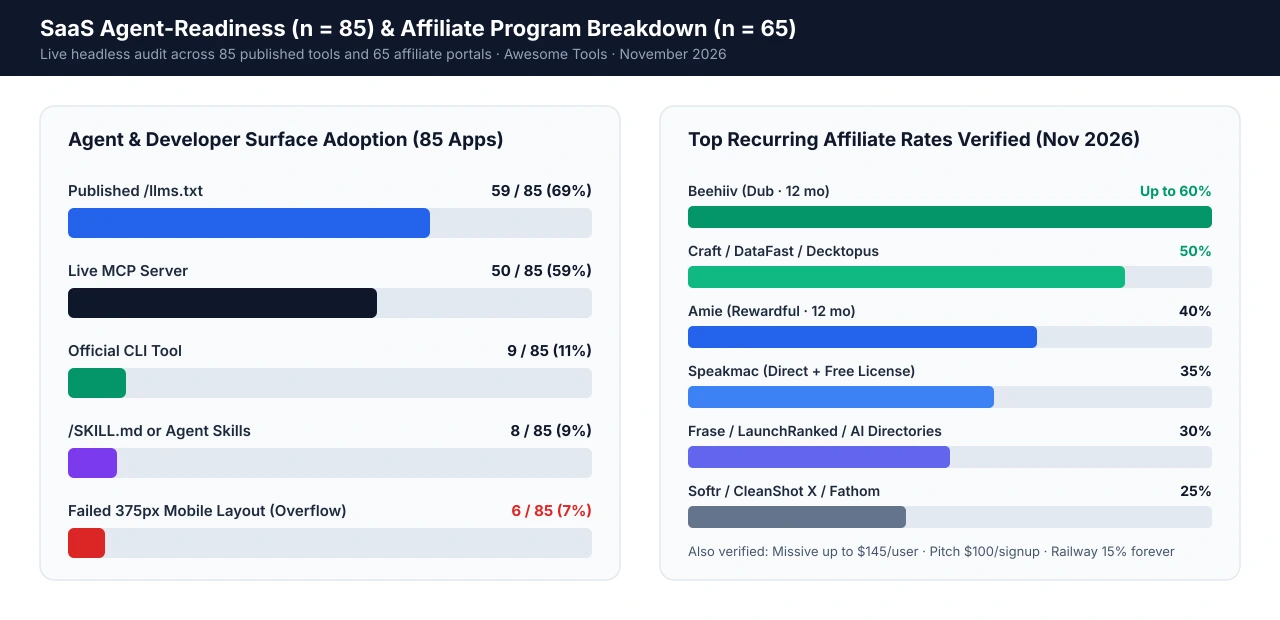
We ran headless browser audits across 85 SaaS products (500+ screenshots) and 65 affiliate programs in November 2026. Here is what changed: 59% ship MCP, 69% publish llms.txt, prompt boxes took over homepages, and 12-month affiliate caps rule.

Some tools linked in this report carry affiliate links on Awesome Tools that may earn a commission at no extra cost to you. Every screenshot, pricing tier, MCP endpoint, and affiliate commission term below was captured live in November 2026.
Most "State of SaaS" reports recycle survey polls from 2024. Instead of sending a questionnaire, we spent November 2026 crawling, screenshotting, and auditing 85 live SaaS websites (500+ desktop 1280x800 screenshots plus 375px mobile layout checks) alongside 65 real SaaS affiliate programs while refreshing reviews across Awesome Tools.
When you inspect 85 pricing pages, developer portals, and affiliate terms back-to-back in a single week, patterns jump off the screen that individual product launches hide.
Here is the short summary of what changed across SaaS in late 2026:
- Agent readiness is no longer niche: 69% (
59/85) publish/llms.txtand 59% (50/85) ship a live MCP server connecting straight into Claude, ChatGPT, or Cursor. - Homepages converged on inline prompt boxes: No-code builders, slide makers, video studios, and internal-tool platforms all replaced static hero screenshots with ChatGPT-style prompt inputs above the fold.
- Free plans are shrinking while suites bundle up: One-time licenses are turning into subscriptions (Screen Studio), email clients merged into full AI suites (Superhuman), and several "free" tiers now block publishing (Glide).
- Affiliate programs settled around 20% to 30% for 12 months: Rewardful still holds 40% (
26/65) of tracked programs, Dub Partners is winning modern PLG flagships, and hidden fine print (SEO bans, customer-only rules, first-purchase-only cuts) separates real payouts from dead links.
Methodology: What We Measured
Between November 17 and November 20, 2026, we ran isolated headless browser sessions across 85 published software tools spanning developer infrastructure, no-code builders, AI video, presentations, SEO, email, design libraries, scheduling, and productivity.
For each product, we verified:
- Live product and pricing pages (exact annual vs. monthly rates, trial credit-card rules, and hidden seat or publishing caps).
- Machine-readable surfaces (
/llms.txt,/SKILL.md,/.well-known/mcp/server-card.json, official MCP endpoints, and CLI tools). - Mobile layout hygiene (
375x812viewport horizontal overflow checks) and consent-banner behavior. - Affiliate and partner portals across 65 programs (
38live wired programs plus27newly discovered portals), verifying commission percentages, recurring caps, cookie windows, and eligibility restrictions.
1. MCP Crossed the Chasm: 59% of Audited SaaS Tools Ship It
A year ago, Model Context Protocol (MCP) looked like a developer-only experiment. In our November 2026 dataset, 50 of 85 audited SaaS apps (59%) ship an official MCP server, and 59 of 85 (69%) publish /llms.txt.
The surprise is not that Supabase, Sentry, Railway, and Retool ship MCP or Agent Skills. The surprise is how fast mainstream non-developer software followed:
- Automation: Zapier reports 500,000+ MCP servers created and 25,000,000+ tool calls across
9,000+apps, while Make ships its official Make MCP Server across3,500+apps. - Design & Presentations: Mobbin exposes
600,000+shipped product screens via Mobbin MCP (search_screens,search_flows), Pitch lets Claude draft editable on-brand decks via OAuth, LottieFiles ships 4 separate MCP servers, and Framer runsmcp.framer.com/mcp. - Email & Meetings: Superhuman ships both Mail MCP and Docs MCP, while Missive, Amie, Akiflow, and Granola all expose remote MCP connectors.
- Niche Verticals: Even Homivo (a Scottish Highlands property search tool) and Simple Photo Gallery ship remote OAuth MCP servers.

The New Pricing Battleground: Free MCP vs. Paywalled MCP
Right now, SaaS founders are split down the middle on how to price MCP access. One camp treats MCP as a product-led growth wedge; the other treats it as an expansion paywall.
| Pricing Strategy | Verified Examples (Nov 2026) | Minimum Plan for MCP | Strategic Pitch |
|---|---|---|---|
| Free / All-Plans Wedge | Softr, Pitch, Sentry, Make, Cal.com, Typefully, Tolt | $0 Free (or every paid plan) | "Bring the Claude or ChatGPT you already pay for and build inside our platform." |
| Trial-Included Wedge | Frase | 7-day card-free trial ($39/mo Starter) | Lets SEO teams test live Claude/Cursor brief workflows before paying. |
| Pro / Business Paywall | Mobbin ($10/mo), Granola ($14/mo), Plus AI ($20/mo), Missive ($24/mo) | $10 to $24/mo | Bundles MCP alongside API access, rules, and deep search. |
| High-Tier Gate | Glide | $125/mo Pro | Reserves "Build with your own agent (MCP)" for 5-seat team plans. |
Look closely at Softr MCP because it signals a major counter-trend for 2027: Bring Your Own AI Subscription (BYO-AI). Instead of charging users twice with proprietary AI credits, Softr explicitly pitches on its MCP page that connecting your own Claude, ChatGPT, or Cursor account burns zero Softr AI credits, even on the Free plan.

CLIs and Agent Skills Are Quietly Returning
Alongside MCP, 9 apps (11%) now highlight official CLI tools and 8 apps (9%) ship /SKILL.md or Agent Skills. Todoist ships an open-source @todoist/cli with a built-in td skill install codex command; Obsidian launched an official CLI; Vercel, Supabase, Sentry, and Railway ship machine-readable skills; and Rewardful offers a downloadable Claude .skill package even without a paid subscription.
2. The "Prompt-Boxification" of SaaS Homepages
Scrolling through 500+ screenshots from this week revealed the single clearest visual shift in software marketing: almost every SaaS homepage now looks like a prompt box.
Across six completely different categories, vendors dropped static dashboard mockups and moved an interactive AI input box straight into the hero section:
- Softr (no-code portals): "Build me a client portal to share..."
- Glide (spreadsheet apps): "Upload spreadsheet -> Start for free"
- Retool (internal dev tools): "Secure your vibe-coded apps" with a Postgres prompt box
- Pitch (slide decks): "Generate a sales presentation for a digital marketplace"
- HeyGen (video studio): "Enter your prompt and we will generate a video for you"
- Zapier (automation): "Welcome to automation in the agentic era" with an interactive "Agentically managed" hero toggle
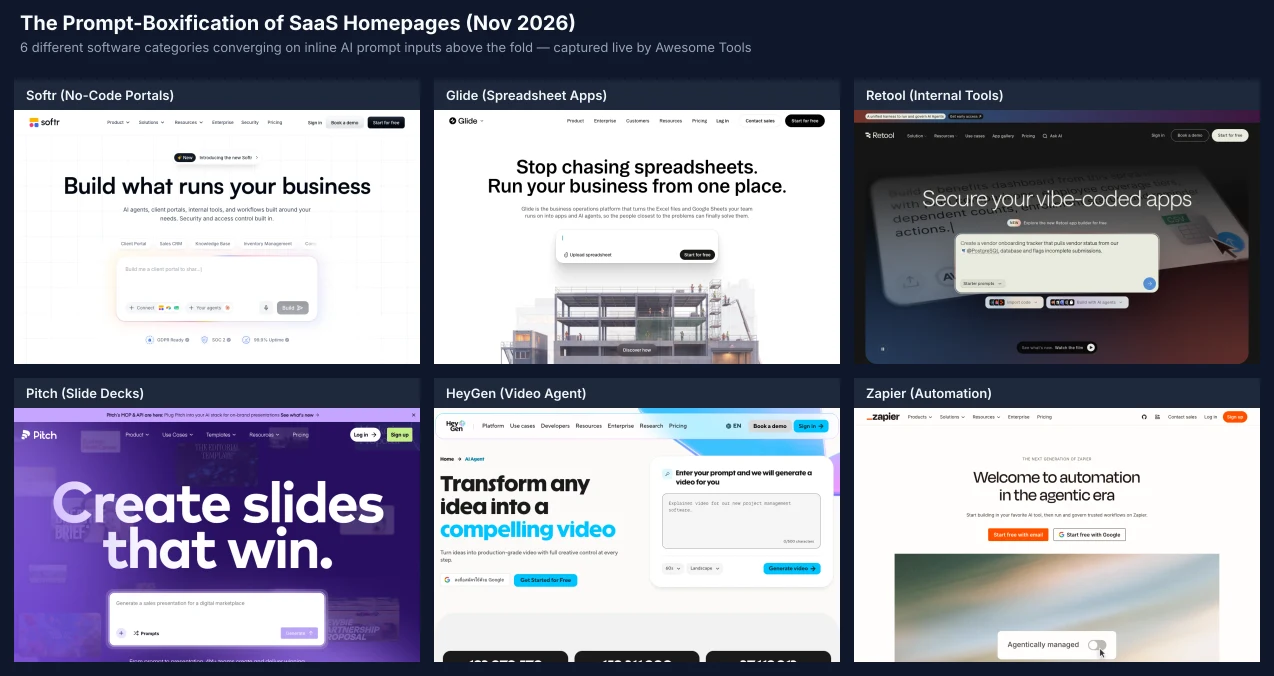
The upside for buyers is lower time-to-first-demo. The risk for founders is visual sameness: when every product leads with a white rounded text box, buyers only see real differentiation once they hit the pricing matrix or try exporting their work.
3. Quiet Pricing Shifts: Suite Bundling, Shrinking Free Plans, and Carded Trials
Checking live pricing pages against stale directory listings exposed four major monetization shifts happening right now:
- Email and writing apps are bundling into multi-product suites. Superhuman rebranded into the Superhuman Suite, bundling Mail, Grammarly, Docs, and Go under one pricing page. Its new
$0Free tier and$12/member/moPro tier cover Grammarly, Docs, and Go, while the standalone Superhuman Mail app still starts at $25/member/mo ($33/mofor the full Business suite). - One-time Mac licenses are getting rare. Screen Studio retired its legacy one-time purchase in favor of subscriptions (
$9/moyearly or$29/momonthly, no free plan). Native Mac holdouts like CleanShot X ($35one-time), Alfred 6 (£40Powerpack), ProcessSpy ($34.99lifetime), and Speakmac ($29one-time) now use one-time pricing as a headline differentiator. - Entry tiers moved upmarket and "free" plans narrowed. Tolt retired its old
$29/moStarter tier ($99/moGrowth is now the entry plan). Chatbase, Beautiful.ai, and Frase all dropped forever-free plans in favor of trials. Glide still advertises a$0Free plan, but it caps you at 0 published apps and 0 enabled workflows. Cursor expanded to five tiers ($0,$8Grok-only Plus,$30Premium,$100Super,$200Ultra). - Trial friction split roughly 50/50. Across the tools with formal trials in our audit, 11 offered card-free trials (Frase 7d, Missive 30d, Tolt 14d, Railway
$530d credits) while 10 required a credit card upfront (Chatbase, Rankability, SiteGPT, Arcads). Watch cancellation fine print closely: Arcads runs a 72-hour carded trial that revokes remaining access immediately if you cancel mid-trial.

4. State of SaaS Affiliate Programs (65 Programs Analyzed)
Alongside product audits, we documented 65 SaaS affiliate and partner programs (38 live wired links plus 27 newly discovered portals). If you run a SaaS company launching a partner program, or a publisher monetizing software reviews, five numbers matter most.
Platform Market Share Across 65 SaaS Programs
- Rewardful (
26/65,40%): Still the default choice for indie, AI, and mid-market Stripe SaaS (DataFast,Arcads,Creatify,Amie,AI Directories,Mail Sweeper,Screen Charm,Outseta,Decktopus). One operational note: Rewardful's signup pages now sit behind strict Cloudflare Turnstile gates, which stops spam bots cleanly. - Dub Partners (
5/65,8%, rapid PLG share): Modern product-led growth flagships are moving topartners.dub.co, including Beehiiv, Cal.com, CleanShot X, Granola, and Framer. - Direct / In-House Portals (
26/65,40%): Split between high-converting bespoke portals (Frase, Softr, Railway, Missive, LaunchRanked) and enterprise agency partner directories (Make, Fireflies, Superhuman). - Enterprise & Creator Networks (
8/65,12%): FirstPromoter (Higgsfield AI,Simplified), PartnerStack (ElevenLabs,Descript), Impact (Craft), Cello (Pitch), Affonso (Affonso), and LemonSqueezy (Screen Studio).
Commission Benchmarks: Where the Real Payouts Live
The median SaaS affiliate program in late 2026 pays 20% to 30% recurring capped at 12 months with a 30-day to 60-day cookie. The outliers below beat that baseline by 2x to 3x:
| Tool | Network / Portal | Verified Payout Structure | Cookie / Key Rule |
|---|---|---|---|
| Beehiiv | Dub Partners | Up to 60% recurring for 12 months | Highest recurring share in our dataset |
| Craft | Impact | 50% recurring on subs, upgrades & renewals (12 mo) | Weekly review cadence |
| DataFast | Rewardful | 50% recurring for 12 months | Strong dev/founder conversion |
| Decktopus | Rewardful | 50% commission | 60-day cookie |
| AI Directories | Rewardful | 30% to 50% (up to $125/sale at 5+ sales) | 30-day cookie, one-time high ticket |
| Amie | Rewardful | 40% recurring for 12 months (up to $72/user) | Open self-serve Rewardful signup |
| Speakmac | Direct Email | 35% commission ($10.15 to $13.65/sale) | 60-day cookie + free Mac reviewer license |
| Frase | Direct Portal | 30% recurring for 12 months | 60-day cookie; high $39 to $239/mo ACV |
| Softr | Direct Portal | 25% recurring for 12 months | $19 to $329/mo plans |
| Missive | In-House Referral | Up to $60 Starter / $100 Productive / $145 Business per user | $1,450 on a 10-seat team; PayPal cash at $450+ |
| Pitch | Cello | Up to $100 per referred sign-up | Flat high-CPA bounty |
| Railway | Direct Portal | 15% recurring on every invoice | No 12-month cliff; compounds with cloud usage |

Three Fine-Print Affiliate Traps to Check Before Writing Reviews
- Channel Bans on SEO Publishers: HeyGen advertises 20% to 30% recurring for 6 months, but its eligibility terms require 5,000+ social video followers and explicitly prohibit blog-only SEO promotion.
- Customer-Only Lock-Ins: Fathom Analytics pays 25% recurring, but retired standalone affiliate accounts; you must keep an active paying Fathom subscription to participate. CleanShot X similarly requires being a user.
- First-Purchase-Only Cuts on Subscriptions: Screen Studio moved customers to recurring subscriptions (
$9/moyearly or$29/momonthly), yet its LemonSqueezy program pays 15% on the initial purchase only (30-daycookie), leaving far less long-term upside than recurring peers.
Finally, notice the zero-affiliate infrastructure gap: category giants like Supabase, Vercel, Sentry, Obsidian, Bear, Todoist, Mobbin, Cursor, Retool, and Zapier skip public self-serve affiliate links entirely. Publishers covering those categories earn by pairing honest reviews of those defaults with affiliate-backed challengers like Railway, Better Stack, Craft, Make, Softr, and Frase.
5. UX & QA Hygiene Gaps We Caught Across Million-Dollar Sites
Because we ran automated 375x812 mobile viewport checks and full visual QA across every site, we also caught concrete hygiene bugs sitting live in production:
- Horizontal mobile overflow (
6/85,7%): Six live marketing sites broke375pxmobile viewports with horizontal scroll leaks: Slidesgo (461/375px), MagicSlides (445/375px), SEO Roast (417/375px), TopView AI (416/375pxon/pricing), ProcessSpy (397/375px), and ElevenLabs (386/375px). - Stale copy and pricing drift: Decktopus had a leftover referral-earnings prompt pasted inside its
/pricingslider; Topyappers cited36Mcreators on one page and44Mon another; and multiple directories still list Frase and Beautiful.ai asfreemiumlong after both retired free tiers. - Shadow-DOM consent banners: Cookie overlays have escalated from simple bottom bars to closed Shadow DOM widgets (
#transcend-consent-manageron Superhuman, plus CookieYes and TrustArc) covering 20% to 30% of above-the-fold desktop height until dismissed.
Takeaways for Founders and Tool Buyers
- If you are building a SaaS product in 2026: Publish a clean
/llms.txt(69%of your peers already do) and ship an OAuth MCP server on your free or entry tier if you want coding agents and AI assistants to recommend and wire your product automatically. Also run a 5-second375pxmobile check on your pricing page. - If you are launching an affiliate program: 25% to 30% recurring for 12 months (with a 60-day cookie) is the competitive floor to attract serious reviewers. If you want high-intent PLG affiliates without friction, Dub Partners and Rewardful are where publishers already keep active dashboards.
- If you are buying software: Check whether a "Free plan" actually lets you publish or export (Glide, HeyGen, Pitch), verify whether MCP is bundled or paywalled, and watch carded trial cancellation terms before entering payment details.
Explore all 85+ live-audited reviews and verified pricing sources in the Awesome Tools directory.